
Durable Air Bags for Commercial Utes: 2026 Buying Guide

Table of Contents
- Durable Air Bags for Commercial Utes: What Actually Lasts
- Airbag Suspension Kits for Utes: Quick Comparison and Pricing
- Airbag Suspension Load Support: Levelling Sag and Uneven Loads
- Vehicle-Specific Fitment: Brackets, Mounts and Kit Compatibility
- Airbag Suspension Maintenance: Inspection Points That Predict Failure
- Airbag Suspension Lifespan: What Service Life Looks Like on Site
- Safety, GVM and Legal Limits: What Air Bags Cannot Fix
- Which Kit Should You Pick?
- Frequently Asked Questions
Last Updated: October 19, 2026
Durable Air Bags for Commercial Utes: What Actually Lasts
Durable air bags for commercial utes are load-assist bellows built to survive daily punishment: constant load cycling, corrugated roads, dust, gravel spray and general neglect.
A bag fails for one of three reasons: the rubber-and-fabric construction wasn't rated for the load it carried, the mounting hardware fatigued, or the air line and fittings leaked until the compressor ran itself to death.
What Separates a Work-Rated Bag From a Cheap One
Work-rated air bags are defined by their load rating, mounting hardware and abrasion resistance, not by the brand name on the box.
Load rating you can verify. Our kits use heavy-duty 2500 pound bellows. Ask any supplier what their bag is rated to, in writing, and how that rating is measured.
Mounting brackets. This is where cheap kits fail first. Heavy-duty steel brackets are essential for supporting the load and preventing premature fatigue.
Air line and fittings. Our kits include 1/4" SAE J10 airline with push-connect brass Schrader valves. These fittings are designed for durability and ease of use.
Airbag Suspension Kits for Utes: Quick Comparison and Pricing
Our airbag suspension kits for utes start at $745 and are model-specific, not universal. Every kit includes two heavy-duty 2500 pound bellows, Australian-made 6mm steel brackets, SAE J10 airline, all fittings, brass Schrader valves and a stainless steel mounting panel.
Vehicle |
Kit Price |
|---|---|
$745 |
|
Ford Ranger, Super Duty, F250 |
$745 |
Nissan Navara, NP300, Patrol |
$745 |
Isuzu D-Max |
$800 |
Mazda BT-50, B-Series |
$745 |
Mitsubishi Triton, Express Van |
$745 |
VW Amarok |
$745 |
Saic LDV T60 |
$765 |
Great Wall V200/V240, Steed, Cannon |
$745 |
If you want on-board control rather than manual inflation at the Schrader valves, every kit can be upgraded with an On Board Air control system to adjust pressure from inside the cab.

Airbag Suspension Load Support: Levelling Sag and Uneven Loads
Airbag suspension load support adds a variable spring rate exactly where the load sits: the rear. This helps maintain optimal suspension geometry under load.
Rear-end sag is more than cosmetic. A ute sitting nose-high throws headlight aim into oncoming traffic and unloads the front axle, which steers and does most of the braking. This compromises safety and vehicle control.
For uneven loads, split left-right inflation on a two-valve manual system lets you compensate for a heavy tool box on one side or an off-centre pallet, ensuring a balanced and stable ride.
Vehicle-Specific Fitment: Brackets, Mounts and Kit Compatibility
Vehicle-specific fitment separates a kit that bolts on in an afternoon from one that fights you for a weekend. Precision-engineered brackets ensure a secure and reliable installation.
Our kits are bolt-on by design, and most fit with basic hand tools and no major modifications. Where drilling is required, we say so up front: F250 and F350 models need drilling and a minimum 190mm tyre-to-chassis clearance, and some Isuzu D-Max TK29/TK30 models built between 5/2012 and 05/2018 need minor drilling.

Lifted vehicles need matching attention. Our Amarok kits are listed separately for standard height, 2" lift and 3" lift, across pre-4/2023 and Next Gen models.
The LDV T60 kit includes a headlight sensor repositioning bracket, a detail most buyers never think to ask about until the headlight levelling system throws a fault after installation.
Airbag Suspension Maintenance: Inspection Points That Predict Failure
Airbag suspension maintenance on a commercial ute is not the same job as maintaining a weekend tow rig. The inspection interval should be driven by duty cycle, not the calendar, and the checks should be specific enough to hand to an apprentice and get a consistent result.
A practical schedule for a work vehicle looks like this:
- Weekly (or every 1,000km): walk-around check of both bellows for visible rub marks, bulging or cracking; confirm both Schrader valves are capped; check that the air line is still clipped away from sharp edges and hot surfaces.
- Monthly: inflate to your normal working pressure, leave overnight, and re-check in the morning. A drop of more than a few psi points to a leak. Torque-check the bracket bolts to the kit specification and look for shiny wear marks around the mounting holes.
- Every service (10,000km or per logbook): full inspection of the air line at every push-connect fitting, the brass valves, and the bracket-to-chassis interface. Wash the bellows down if the vehicle has been on unsealed roads or in mud.
- Annually, or before any heavy towing season: pressure-test the system, inspect the compressor and tank if fitted, and replace any line that shows chafing or UV cracking.
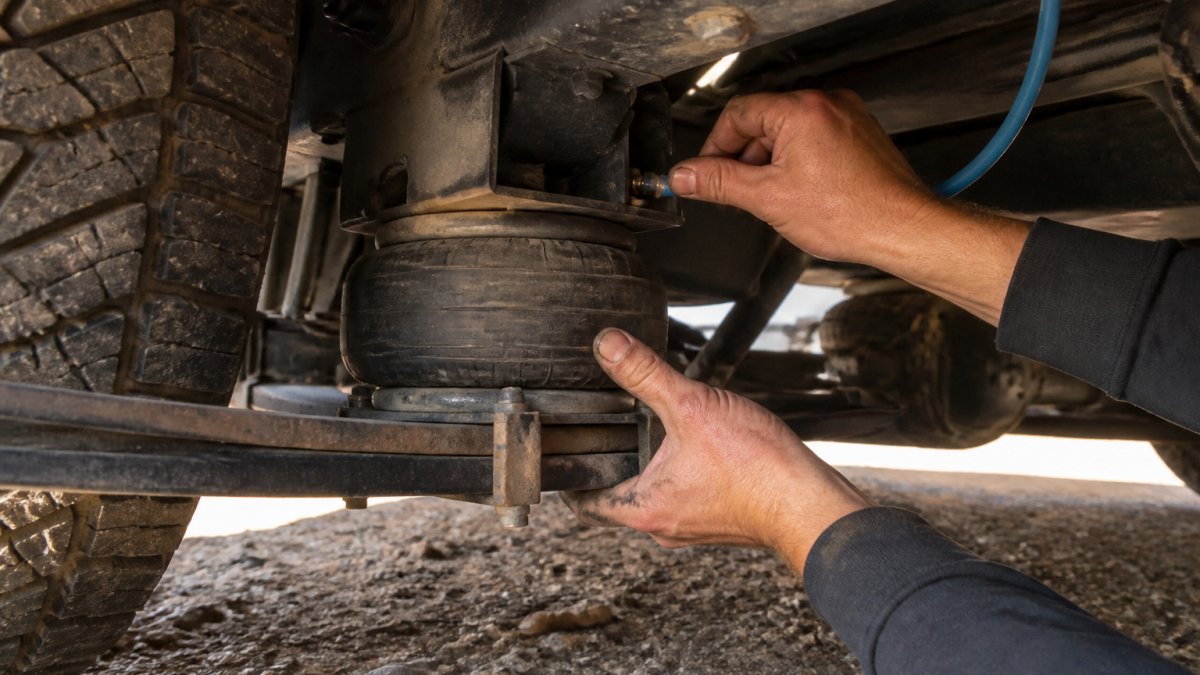
The Five Inspection Points That Predict Failure
- Bellow surface: look for cracks, abrasion rubs or bulging. A rub mark means something is contacting the bag under articulation; find it and fix the routing before the bag wears through.
- Air line at the fitting: the push-connect joint is the most common leak point. Check for chafing where the line passes through or near metal, and confirm the line is fully seated in the fitting.
- Fittings and valves: brass Schrader valves should be capped. Dust ingress is what kills them, and a failed valve is a cheap part that becomes an expensive diagnosis if left.
- Bracket bolts: check torque, and look for cracks or shiny wear marks around the mounting holes. A bracket that has started to move under load will show a polished ring around the bolt head.
- Pressure retention: inflate to your normal setting, leave it overnight, and check again. A slow drop points to a leak you haven't found yet, usually at a fitting rather than the bag itself.
Replacement Indicators and Lifecycle Cost
A bellows is due for replacement when you see persistent surface cracking, a bulge that does not disappear when deflated, or a leak that returns after a fitting repair.
The lifecycle cost of a work-rated kit is dominated by the cost of the bellows and the labour to fit them. Because our kits use bolt-on brackets and standard SAE J10 line, a bellows replacement is straightforward rather than a fabrication exercise.
Wash the bags down after heavy mud or gravel work. Grit trapped between the bellow and its seat acts like sandpaper every time the suspension cycles, and on a vehicle that sees unsealed roads daily that wear adds up fast.
Airbag Suspension Lifespan: What Service Life Looks Like on Site
Airbag suspension lifespan on a commercial ute is governed by load cycles, not calendar years. A ute running fully loaded five days a week on unsealed roads works its bags far harder than a weekend tow vehicle, and the inspection schedule and expected service life should reflect that.
Defining the Duty Cycle
A useful way to think about lifespan is to count load cycles rather than kilometres. For a heavy-duty commercial ute, loaded most days, regularly on unsealed or corrugated roads, expect the bellows to need inspection at every service and replacement at some point during the vehicle's working life. For a light-duty ute loaded occasionally, the bellows will often outlast the ownership period.
What Actually Ends a Kit Early
On site, the pattern is predictable. Bags that fail early almost always show one of three histories:
- Over-pressured to compensate for a sagging leaf pack. Running maximum pressure every day to fix a tired spring pack overloads the bellows and the brackets. The bag may survive; the hardware usually does not.
- Air line routed against a sharp edge. A chafed line is a slow leak, and a slow leak means the compressor runs constantly until it fails. This is a routing problem, not a bag problem.
Evidence From Commercial Use
The durability claim that matters to a fleet buyer is not 'heavy-duty' on a product page, it is what the kit is built from. Before purchase, ask three questions: what is the bellows rated to, in writing; what is the bracket made from and how thick is it; and is the kit model-specific or universal. A supplier who cannot answer all three clearly is selling a kit not designed for daily commercial work.
Safety, GVM and Legal Limits: What Air Bags Cannot Fix
Air bags cannot increase your GVM, your axle load rating or your legal payload. These are critical safety and legal limitations.
Gross Vehicle Mass and axle load limits are set by the manufacturer and, where modified, by an approved modification. It is crucial to operate within these legal parameters.
Two practical rules follow. First, load to your placarded limits and use the bags to keep the vehicle level within them. This ensures optimal handling and braking performance.
For towing, the same logic applies to towball weight. Ensure your towball download is within the manufacturer's specifications.
Which Kit Should You Pick?
Pick the kit that matches your exact model, build date and lift, then decide between manual inflation at the valves or an On Board Air control system in the cab.
If you run a Hilux, Ranger, Navara, D-Max, BT-50, Triton, Amarok, LDV T60 or Great Wall, we make a vehicle-specific kit for it, priced between $745 and $800, with everything in the box. If you are adding on-board air, pair the kit with an Aluminium Air Tank at $160, built from 5052 2.5mm heat-treated polished aluminium with a 0-200psi working pressure and a 400psi burst pressure, available in 1, 3 and 5 gallon volumes.

Thor Air Suspension has spent over 36 years of combined industry experience designing Australian-made air suspension for exactly that duty cycle, with heavy-duty 2500 pound bellows, Australian-made 6mm steel brackets and SAE J10 airline in every kit.
Frequently Asked Questions
Are air bags suitable for commercial utes carrying heavy loads every day?
Yes, provided the kit is matched to the vehicle and the load stays within the ute's legal limits. Load-assist bags work alongside the existing leaf or coil springs to hold ride height, reduce rear-end sag and keep steering and braking predictable. The bags do not raise the payload figure on the compliance plate, so check your GVM and axle loads first. Daily work use makes bracket strength and air line routing the deciding factors.
How long do air suspension airbags typically last?
Service life depends on load, terrain and inspection habits rather than a fixed number. Rubber-and-fabric bellows degrade faster with constant over-inflation, abrasive dust and fittings left unchecked. On work utes doing daily gravel and site driving, the fittings and air lines usually need attention before the bag itself. Checking for chafing, moisture in the lines and correct pressure settings every few months is the single biggest factor in extending airbag suspension lifespan, and it costs nothing beyond a few minutes under the tray.
Do air bags increase a ute's legal payload or GVM?
No. Air bags change how the vehicle carries a load, not how much it is legally allowed to carry. The GVM and axle load limits on the compliance plate stay exactly as they were. What the bags do is restore ride height and suspension geometry so the weight you are already permitted to carry sits properly on the axles. If you need a higher payload, that requires a GVM upgrade approved under the relevant state or territory rules, which is a separate engineering process.
What are the downsides of fitting air bags to a work ute?
The main downsides are ongoing pressure management and inspection. Manual Schrader valves mean you adjust pressure as the load changes, and an empty tray on hard-inflated bags rides stiffly. Air lines are also exposed to sticks, gravel and scraped trays on site, so routing matters. Some kits need minor drilling for certain model years. None of these are deal-breakers, but they explain why fitment quality and a clear inspection routine separate a kit that lasts from one that leaks within a season.